
A straightforward home EV charger installation in Tunbridge Wells and the wider Kent area typically costs £500 to £900, depending on the charger you choose, the length of the cable run and the state of your consumer unit. Longer runs, groundwork or a consumer unit upgrade add to that. The £500 government grant is now only for renters and flat owners, not homeowners in houses.
Prices for home chargers vary a lot, and a headline figure often leaves out the work that turns a simple job into a bigger one. This guide explains what a standard installation should include, what pushes the price up, who can still get a grant in 2026, and how to get an accurate quote.
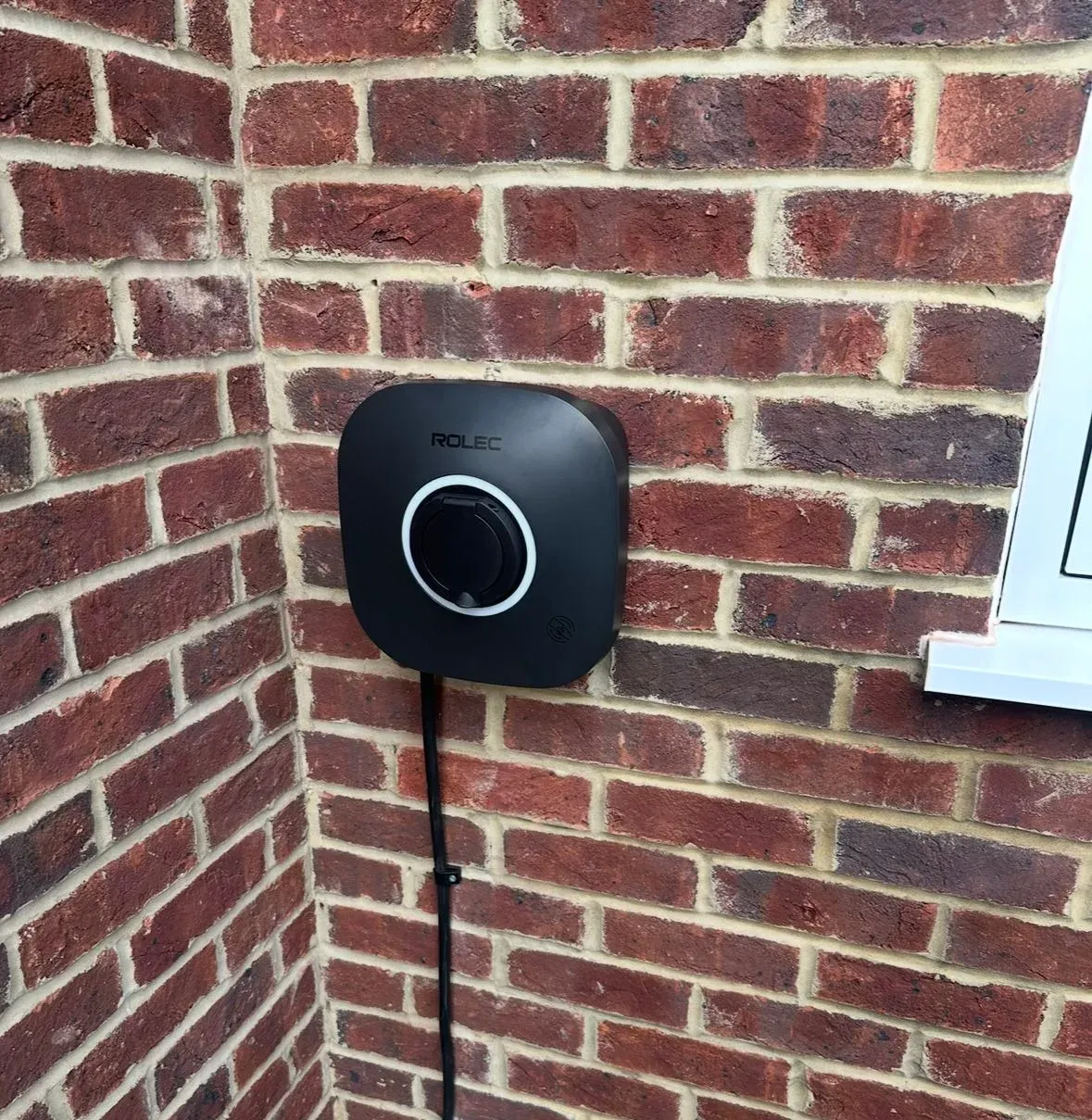
How Much Does EV Charger Installation Cost?
| Installation | Typical cost | Notes |
|---|---|---|
| Standard 7kW smart charger, supplied and fitted in Tunbridge Wells | £500 to £900 | Varies with the charger model, the cable run and your consumer unit |
| National price guides, 2026 | £800 to £1,200 | A typical UK figure for a smart charger fitted, for comparison |
| Three-phase or 22kW chargers, or several chargers | Priced individually | Needs a site survey and often a supply check with the network operator |
Every quote we give is a fixed price agreed before the work starts, after a free site visit. The figures above are for straightforward installations. The next two sections explain what is included and what can add to the price.
What a Standard Installation Includes
- A smart charger. Since June 2022, every charger sold for home use in Great Britain must be a smart charger under the Electric Vehicles (Smart Charge Points) Regulations 2021, so it can schedule charging for cheaper off-peak hours. We fit leading brands including Zappi, Rolec, Ohme, Pod Point, Andersen and Easee.
- A dedicated circuit from your consumer unit, with the right protective device and RCD protection for an EV charger.
- Earthing protection. Most UK homes have a PME earth, and the wiring regulations require protection against a rare but serious fault on the supply cable (an open PEN fault) for outdoor chargers. Most modern chargers have this built in. Otherwise an earth rod is needed.
- Mounting and a cable run of a reasonable length from the consumer unit to the parking space, usually clipped neatly along an outside wall.
- Testing, commissioning and certification, with an Electrical Installation Certificate. A new circuit is notifiable under Part P of the Building Regulations, which a NAPIT registered contractor can self-certify.
- Notifying the network operator. In Kent that is UK Power Networks. Your installer tells them about the new charger, and if it would push your home's demand beyond what your supply can provide, they have to approve it first.
- Setting up the app and your tariff schedule, so the car charges at the cheapest times.
What Can Add to the Cost
These are the extras that most often turn a standard installation into a bigger job. The ranges are typical figures from national price guides in 2026. We price your job individually after the survey.
| Extra | Why it is needed | Typical extra cost |
|---|---|---|
| A longer cable run | The consumer unit is a long way from the parking space, or the cable has to go through the house | £100 to £400 |
| Groundwork | The cable has to go under a drive, path or lawn to reach a detached garage or a separate parking space | £200 to £1,000 |
| Consumer unit upgrade | An old fuse box, no spare space, or no suitable RCD protection for a new circuit | £500 to £900 |
| Supply or main fuse upgrade | The home's supply is too small for the extra demand, which is more common in older properties | Arranged with UK Power Networks; depends on your supply |
| Earth rod | The charger has no built-in protection against an open PEN fault | Usually a small extra, and rarely needed with modern chargers |
If your fuse box is old, our guide to signs your home needs rewiring explains when a consumer unit upgrade is worth doing anyway. We carry out consumer unit replacements as part of our rewiring work.
EV Charger Grants in 2026: Who Can Still Claim
Government grants for home chargers rose from £350 to £500 on 1 April 2026, and funding is available until 31 March 2027. But they are no longer open to everyone. If you own and live in a house or bungalow, you cannot claim. That has been the case since the old Electric Vehicle Homecharge Scheme closed to homeowners in April 2022.
| Grant | Who it is for | Amount |
|---|---|---|
| Renters and flat owners | People who rent any home, or own and live in a flat, with private off-street parking they have the right to use | 75% of the cost, up to £500 |
| Households with on-street parking | Owners or renters with only on-street parking, installing an approved cross-pavement channel | Up to £500 |
| Landlords | Private landlords, social housing providers and property managers | Up to £500 per socket, up to 200 sockets |
| Workplace Charging Scheme | Businesses, charities and public sector organisations | Up to £500 per socket, up to 40 sockets |
The way you apply also changed in April 2026. For the renter and flat owner grant, you now apply yourself through GOV.UK, and you must not have the charger installed until the Office for Zero Emission Vehicles (OZEV) has confirmed you are eligible. Your car has to be on the approved vehicle list, the charger has to be an approved model, and the installation has to be carried out by an OZEV-authorised installer, so check this before you book. Flat owners and renters also need written permission from the freeholder or landlord before applying.
For households with on-street parking, the cross-pavement channel needs approval from the highway authority. In Tunbridge Wells and the rest of Kent that is Kent County Council, so check their position before you commit.
Things That Affect the Cost in Tunbridge Wells and Kent
A few local factors come up often. Many older homes around Tunbridge Wells have the meter and consumer unit at the front of the house, under the stairs or in a cellar, a long way from the drive or garage, which means a longer cable run. Older supplies are more likely to need a check with UK Power Networks before a charger is added. If your home is listed, or in one of the borough's conservation areas, the position of the charger may need consent, so it is worth checking with Tunbridge Wells Borough Council before installation.
Choosing a Charger: Tethered or Untethered, and Which Brand
A tethered charger has its cable permanently attached, so you just unhook it and plug in, which is the most convenient option for everyday use. An untethered charger has a socket only, and you use the cable that came with your car. It looks tidier on the wall and works with any car, but you take the cable out of the boot each time. Almost every new electric car sold in the UK uses the same Type 2 connector, so either type will suit most drivers, and the price difference between them is usually small.
The right brand depends on your home more than the badge. Among the chargers we fit most often:
- Zappi suits homes with solar panels, because it can send surplus solar power straight to the car.
- Rolec is a good value choice for charging on an off-peak tariff.
- Easee suits homes or small businesses charging more than one car, as it balances the load between chargers.
Whichever you choose, a 7kW charger is about three times faster than a standard 3-pin socket, adding around 25 miles of range an hour, and it is built to run at full power for hours, which household sockets and extension leads are not.
What It Costs to Run
The installation is a one-off. The running cost depends on your tariff, and charging at home overnight on an EV tariff is usually far cheaper than public rapid charging. Our EV charging cost calculator works out what a full charge costs at home, on public chargers and compared with petrol, and our greenest time to charge tool shows when the grid is cleanest today.
How to Get an Accurate Quote
To get a firm price quickly, send us three photos: your consumer unit with the cover on, your electricity meter, and the spot where you want the charger, ideally showing the route back to the house. We will usually spot any likely extras from those, then confirm everything at a free site visit and give you a fixed price. Find out more about our EV charger installation service, or get in touch for a quote.