
The safe, permanent way to get electricity to a garden shed or garden room is a new circuit from your consumer unit, run in steel wire armoured (SWA) cable that is either buried with warning tape above it or fixed along a wall or fence. It usually feeds a small consumer unit inside the building, the circuits need RCD protection, and the job counts as notifiable work under Part P, so it should be installed and certified by a registered electrician.
What changes from job to job is how big the cable needs to be, which route it takes and what the building will be used for. A shed with a light and a socket for the mower is a very different job from a garden office with heating, air conditioning and a desk full of computers. Here is how it works and what to plan before anyone starts digging.
This guide is for homeowners in England planning power to a shed, workshop, garden office or gym. It explains what a safe installation involves so you can plan the job and compare quotes. It is not a DIY wiring guide.
Your Options for Powering a Shed
| Option | Good for | Watch out for |
|---|---|---|
| Extension lead from the house | Occasional use while you are out there | Not safe as a permanent supply; gets cut, crushed and wet |
| Buried armoured cable | Most sheds, workshops and garden rooms | Digging across lawns or patios; needs a recorded route |
| Armoured cable along a wall or fence | Buildings close to the house with a fixed boundary to follow | Must be clipped securely and kept away from where it can be knocked |
| Overhead cable | Short spans where digging is impossible | Has to be high enough to clear people and vehicles; rarely the neatest option |
| Small solar kit | A light or phone charger in a remote shed | Very limited power; will not run tools or heaters |
For anything you plug in outdoors in the meantime, Electrical Safety First's garden safety advice is to use an RCD with all outdoor electrical equipment and only extension leads made for outdoor use.
Why Armoured Cable
Ordinary twin and earth cable, the flat grey cable used inside houses, is not designed to be buried or left exposed outside. Steel wire armoured cable has a layer of steel wires around the conductors, which protects it from spades, forks and rodents, and which also acts as a protective earth. The wiring regulations, BS 7671, require a buried cable to be armoured or run in a protective duct, deep enough to avoid foreseeable digging, and marked with cable covers or warning tape. Common practice is around 600mm under lawns and flower beds. Where the route crosses a patio or driveway, running it in a duct means it can be replaced later without lifting the surface.
Shed vs Garden Room: Sizing the Supply
The cable size depends on two things: how much power the building will draw and how far it is from the house. A shed with LED lights and a couple of sockets needs a modest supply. A garden office or gym with an electric heater, air conditioning, a kettle and computers needs a much bigger one, and long runs to the bottom of a Kent garden need a larger cable again to stop the voltage dropping too far. It is worth planning for what you might add later, such as an EV charger near the shed or a hot tub, because upsizing the cable at the start costs far less than digging a second trench.
What Goes Inside the Building
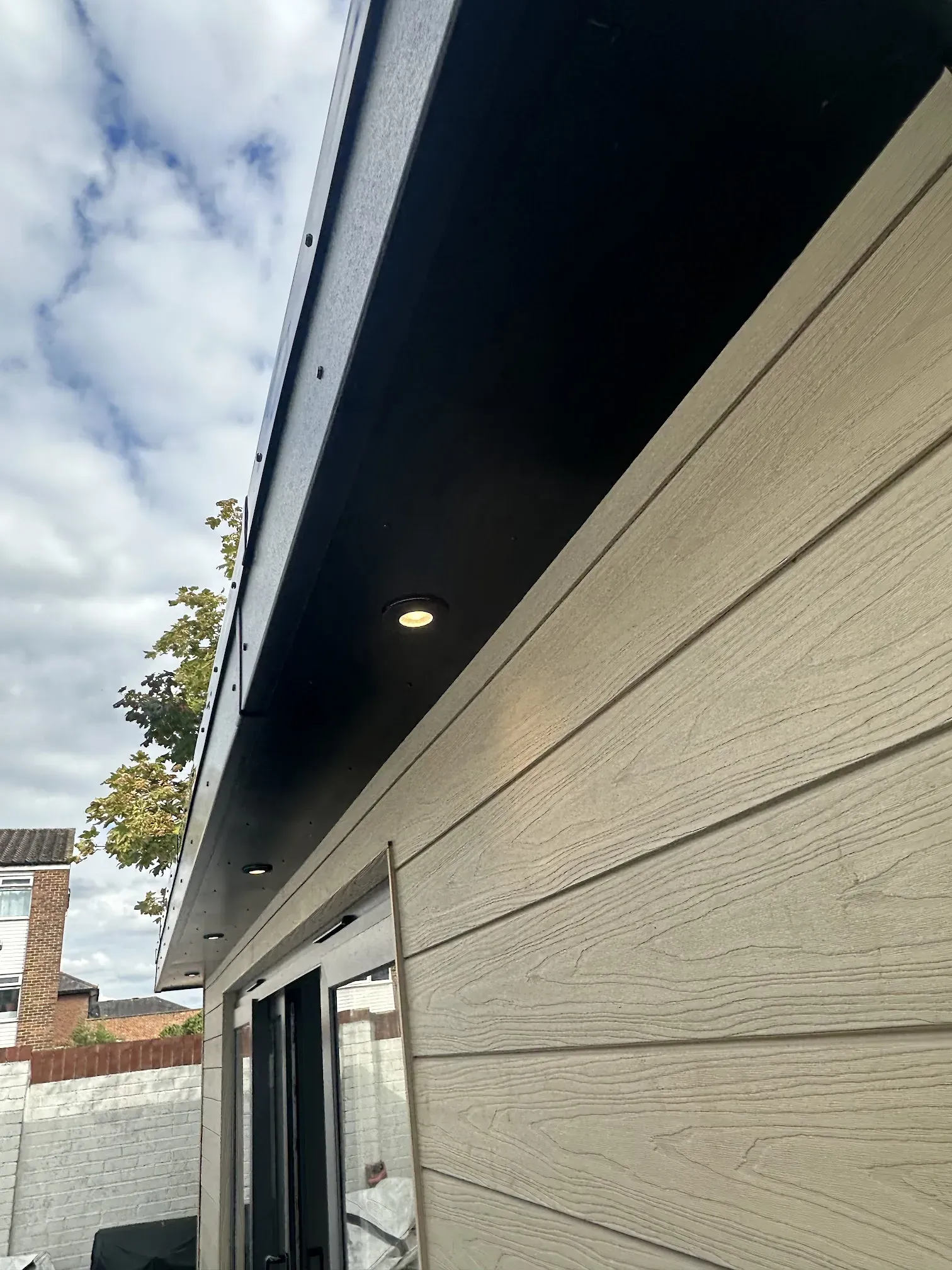
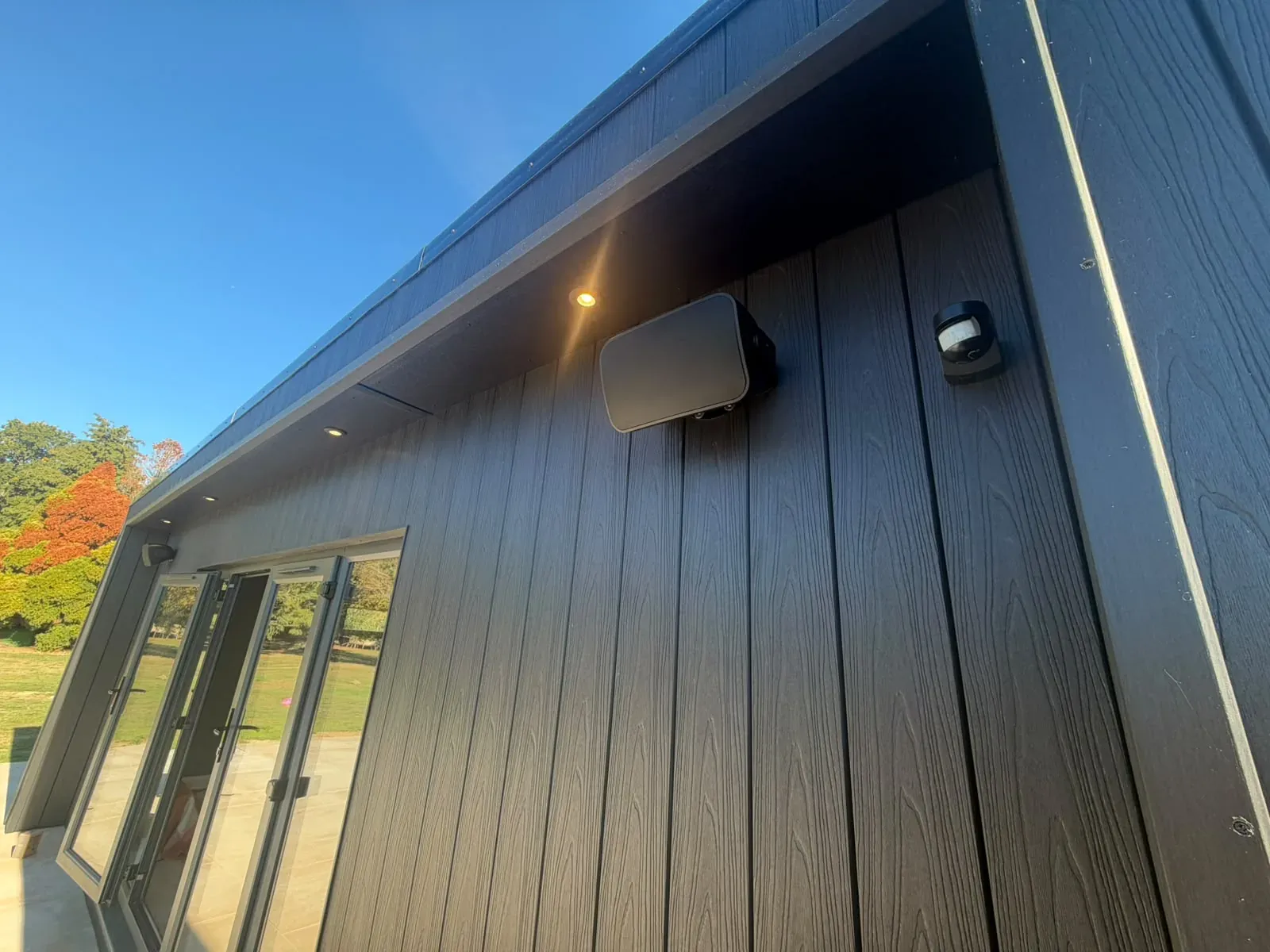
Most outbuildings get a small consumer unit of their own, so the lights and sockets are on separate circuits and you can isolate the building without going back to the house. From there, the electrician fits sockets, lighting, any outside lights on the building and dedicated circuits for heaters or air conditioning. The garden room in the photo has LED downlights set into the soffit, a simple way to light the doors and path at night. We also fit garden lighting, outdoor speakers and wired internet to garden offices, and it makes sense to lay a data cable in the same trench as the power.
Earthing and RCD Protection
The sockets and circuits in an outbuilding need RCD protection, either at the house consumer unit or in the outbuilding's own unit. An RCD cuts the power in a fraction of a second if current leaks to earth, for example through a damaged cable or a wet tool. Earthing needs more thought. Depending on the type of supply your house has and what the outbuilding is made of, the electrician may connect it to the house earth or give it its own earth rod. This is one of the main reasons outbuilding supplies should be designed and tested by someone qualified rather than added on as a DIY job.
Part P and Certification
A new circuit to a shed or garden room is notifiable work under Part P of the Building Regulations. Before the 2013 revision of Approved Document P, almost all outdoor electrical work was notifiable; now most of it only needs notifying when it involves a new circuit, which a supply to an outbuilding always does. Because we are registered with NAPIT, we notify the work for you, and you receive an Electrical Installation Certificate plus a Building Regulations compliance certificate. These matter when you sell the house, and our guide to electrical certificates explained covers what each one is for.
What Affects the Cost
- Distance from the consumer unit to the building, which drives the length and size of the cable
- The route: digging through a lawn is quicker than lifting a patio, and a wall or fence run can avoid digging altogether
- What the building will run: lights and sockets only, or heating, air conditioning and office equipment
- Your consumer unit: if it has no spare way or lacks RCD protection, a consumer unit upgrade may be needed first
- Earthing: whether an earth rod is needed at the building
- Extras: outside lights, speakers or a data cable in the same trench
We give a fixed price after a free look at the route and the consumer unit, so you know the full cost, including testing and certification, before any digging starts.
Planning a Garden Room? Talk to the Electrician Early
If a garden room is being built, the best time to plan the electrics is before the base goes down. A duct laid under the base and along the route lets the cable go in cleanly later, and agreeing socket, light and heater positions with the builder avoids surface-mounted cables afterwards. Our team works across Tunbridge Wells, Tonbridge, Sevenoaks and the wider Kent area on new installations including sheds, workshops and garden rooms. Get in touch for a free quote.